This here will be my Linda Mecklenburg International Handling seminar write up/blog post. It will be added to as my writing gets done. It was a Saturday and Sunday seminar taking plays at the IncrediPaws (Jennifer & Susan Crank’s place) indoor agility place in Reynoldsburg Ohio.
Linda Mecklenburg Two Day International Handling Seminar
Part One (aka Saturday morning only)
Linda started off by talking about how she saw the next two days progressing starting off with drills, then to medium length sequences and then onto full courses by the end of Sunday afternoon. She wanted to address the individual skills that the international courses are requiring and the fact that in Europe none of these are considered anything special – they are just standard skills that handlers train from the beginning so they can perform all these skills “without thought” simply because their courses are designed this way. American handlers (and I added in my head Australian handlers) do not see courses with these kinds of sequences so they do not train for them. The course designs they see in AKC and USDAA and NADAC etc etc never have these kinds of obstacle arrangements. Linda found when she competed at the EOs that she could handle all the courses but that she found she was having to “think” about it because it was not something that felt as natural to her. So she has to train these things at home. So she has come up with drills and sequences to help her do that.
We started of with the Push To The Back of The Jump Drill.
Linda has a verbal command for it – “Back” so that Wonder knows that when they are running towards a jump and he hears that verbal (combined obviously with her motion and arm cues) he knows to always go around to the back of the jump. It’s something she started off by training with just a cone on the ground. Throughout the discussion of this skill she always emphasized the fact that you need to have a really good understanding of what the command actually means to the dog.
The first drill is 2 jumps set up as per image. And basically pole turns. See diagram.
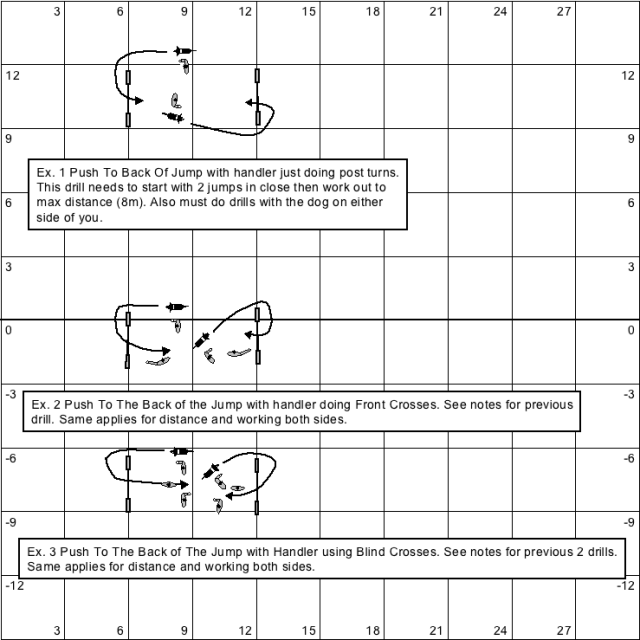
Image 1.
What struck me as significant here is that I was also thinking about the importance of the dog’s understanding of not taking obstacles unless cued to do so. This always brings up a bit of a sticky issue for me. I decided a long time ago that I don’t want to be tied down to having to give a verbal for every jump I want my dogs to take – I think there’s at least 5 other cues they can go off and the less I need to say on course the better. But this then creates another problem. By not using a verbal all the time for taking jumps I am in sense creating a culture of independency. There will be situations when I need the dog to run beside me or by me very close to jumps/obstacles I don’t want them to take. Or I may be running straight at a tunnel entry and NOT want the dog to take the tunnel.
Now Linda was saying that her dogs would not take the tunnel UNLESS she had also given the verbal TUNNEL.
When working at a distance I always have to give the clear verbal command TUNNEL to get my dogs to go away from me and do the tunnel….however if I am running full pelt at the tunnel there will be a point at which my dogs no longer need a verbal to take the tunnel – they will take it UNLESS I cue otherwise in a timely fashion.
What Linda said had me imagining that there was no point like that for her dogs – she would always have to give the verbal TUNNEL if she wanted the tunnel otherwise the dog would run past it presumably. The same as she always says JUMP for when she wants her dog to take a jump.
This had me thinking that the strength of the verbal for taking the back of the jump is very much dependent on how much the dog relies on verbals to take obstacles. I use verbals for things like weaves, walk, aframe, tyre, tunnel, seesaw but I don’t tend to use verbal for the jumps UNLESS my motion and position on course does NOT support the jump. For example dog comes out of straight tunnel and needs to do the jump directly in their path say 5 meters away however I need to move laterally away to get up to manage an upcoming sequence.
My body is moving away from the jump, so I swing my arm out clearly indicating the jump and say “GO HUP”. That is when I verbally cue jumps (and also when I think the jump might not be in their direct line of sight), other than that I just expect my motion, body position, arms, eye contact, shoulders etc to be enough to tell my dogs to take jumps.
Motion is always the strongest cue for our dogs and I often feel the verbals have very little impact a lot of the time on course but you get what you train. Number 1 on my training list is teaching my dogs not to jump unless I give a verbal cue. It’s good for a number of reasons but it certainly determines the effectiveness of teaching a verbal cue to go round and take the back of a jump. Personally I think the most difficult aspect is going to be getting used to running flat out and talking so much to my dogs. But that’s a cardiovascular fitness thing not a training thing 😉
Exercise 2 is as the image 1 shows – Push To Back of Jump using Front Crosses.
Exercise 3 – Push to back of Jump using Blind Crosses. As shown in the Image 1.
Blinds need to become far more natural than they are currently performed. I’m SEEING a lot of blind crosses on courses. I shouldn’t be “seeing” them. Linda said you know when blind crosses are being performed correctly because you didn’t notice it happen as it happens when you watch someone running a course. You might think afterwards “Oh yeah they did a blind cross there” but if you are watching a run and go “Woah!! Blind cross!!” that person probably didn’t execute that BC to the best level of efficiency and smoothness. I can’t even talk for myself as I feel that I am very much at the stage where I have avoided them for 15 of my 17 years in the sport so I’m very much still in the “thinking” mode when it comes to do them. REPETITION. That’s the only thing that is going to improve this. Plus not going overboard. In an effort to become better at them I have seen people doing them on courses where no significant advantage is gained by actually doing them. You want to practice them do it in training don’t just plonk it in your handling on a course because “well it’s new and I should be better at them and it could totally be done there” – do it if it gives you a significant advantage. I think more thought needs to be given in training sequences when we want to train blind crosses towards coming up with sequences that make absolute sense. I don’t think I’ve worded that point well. I may come back to this.
Anyway the upshot of these three drills/exercises brought home to me the importance of training the verbal cue to get a dog to take a jump. Back to one jump work when I get home.
After the first three drills Linda then placed the two jumps perpendicular and indicated the paths we should be taking when doing the same first three drills in this particular arrangement of jumps. See image below.
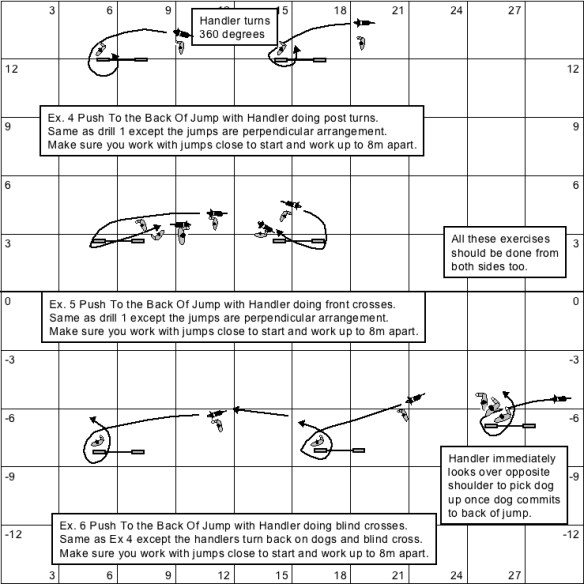
Image 2.
The next few drills involved three jumps.
Some noted observations from Linda after having worked with Jakko and Juanita, the Finnish handlers.
- We tend to overdo the motion needed to the edge of the wing to get the back of jump behaviour.
- The verbal is important especially if you are still required to compete regularly on relatively uncomplicated straight forward courses such as the ones we see in AKC (and in our case ANKC)
- The verbal CANNOT be two commands ie you can’t say ROUND and then JUMP. You don’t have time and it clouds something that should be all one behaviour. Two verbals are too much talking on course. One verbal should mean “go to back of the jump and take it”
- The Finnish don’t tend to use a verbal at all, just one step in the right angle/spot the dog reads it as back of the jump, but this is also related to the fact that many of them are on top of the jump when they want the normal forward jump approach, especially for turns as they don’t want the dog to have more than half the length of bar to jump.
MORE TO COME…
 Sprytelee Agility Training